Next steps
Congratulations, you have created your first EventCatalog.
This is a real catalog now. It models architecture primitives, links them together, and gives people a place to understand how part of your system works.
Your catalog now has...
The first pieces of a useful architecture catalog
- Services that describe the systems in your architecture.
- An event with producer and consumer relationships.
- A schema that explains the event payload.
- Ownership and a domain to group the work.
- Visualizations and a production build path.
This is enough to give people a useful first view of your architecture. From here, you can keep adding detail in the way that fits your team.
See a fuller catalog
The tutorial catalog is small on purpose. EventCatalog can model many more architecture primitives, including services, events, commands, queries, channels, data stores, data products, agents, owners, domains, flows, and the relationships between them.
You can explore the public EventCatalog demo catalog to see a larger example.
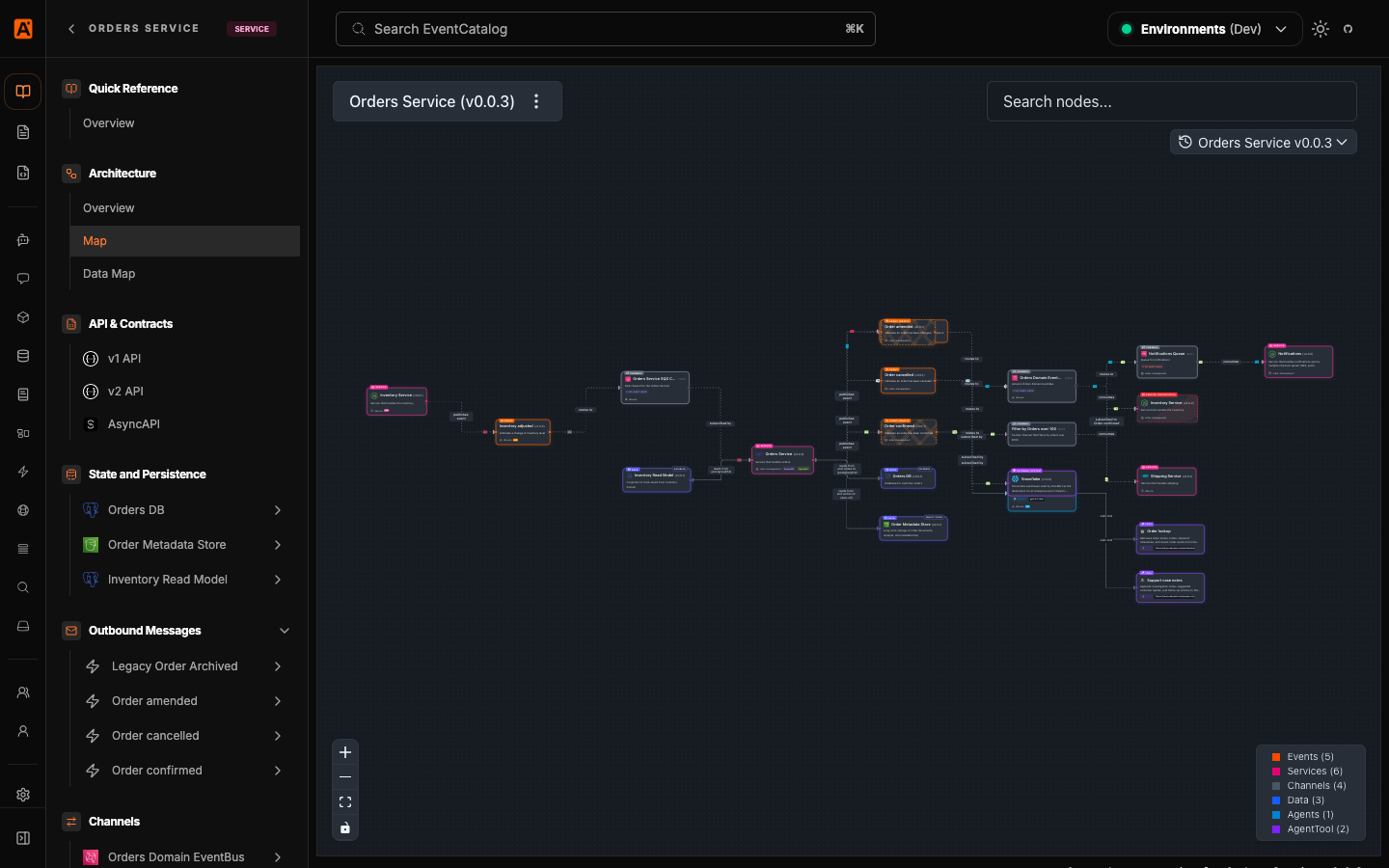
The demo catalog visualizer shows services, events, channels, data stores, agents, and workflows connected together.
Open this view in the demo catalog.
Add more documentation
Every resource page is Markdown and MDX. You can add more explanation, diagrams, links, runbooks, examples, or any other content that helps people understand the system.
Useful docs:
Edit visually with EventCatalog Editor
If you prefer a visual local editor, try EventCatalog Editor. It runs locally and gives you a UI for editing the catalog files in your project.
Automate from existing specifications
You do not have to maintain everything by hand. EventCatalog can generate catalog resources from specifications and registries.
Useful plugin docs:
Model more architecture primitives
The tutorial focused on services, events, schemas, owners, and domains. EventCatalog can model more of your architecture as your catalog grows.
Use these docs when you are ready to add more primitives to your catalog:
Keep improving the catalog
Start small, keep the content close to the systems it describes, and add more detail when people ask questions the catalog cannot answer yet.