Documentation designed for software, not generic wikis.
Document with software primitives including domains, systems, services and messages. Stays in sync with your specifications and code base.
Open source. Self-hosted. AI-ready.
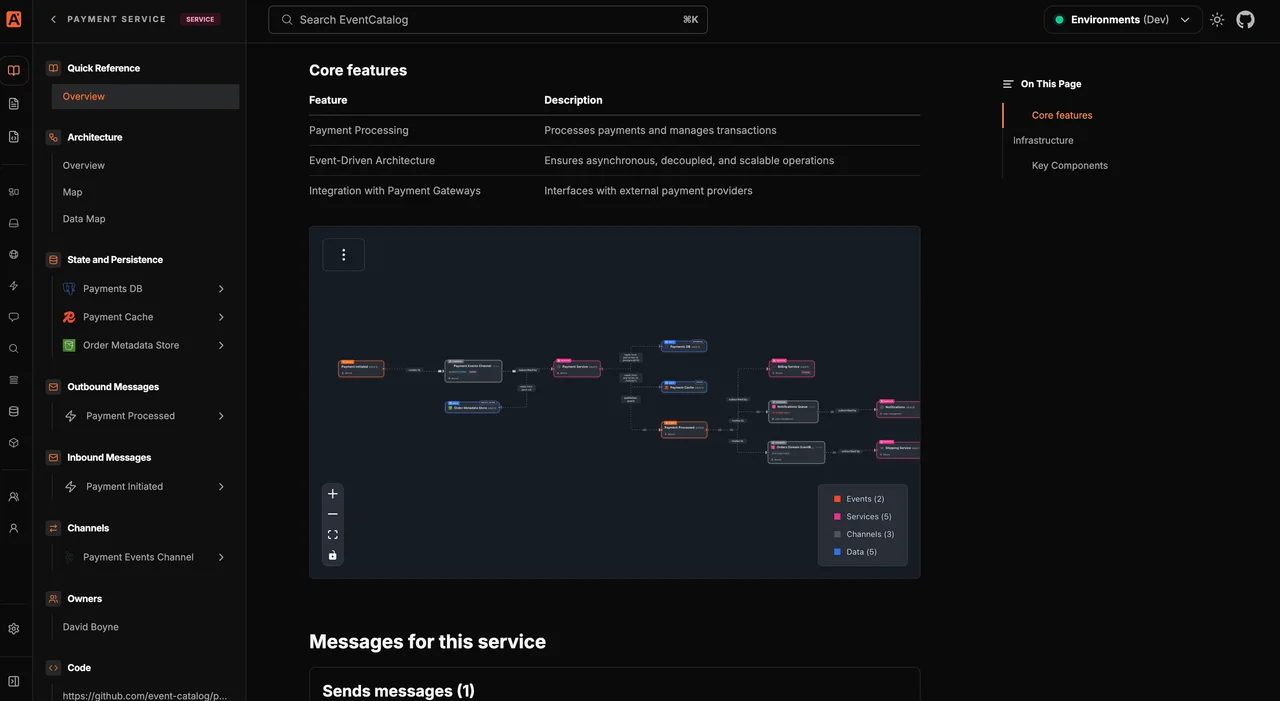








In distributed systems, if you can't find it, it doesn't exist.
When every service, event, and schema has an owner and clear relationships, teams can reason about change before it breaks something.
Find what exists. Find who owns it.
No more searching across repos to understand the system
Document your domains, services, and messages.
Stop asking in Slack. Find what you need in seconds.
Search by name. Query by AI. Both work.
Find what you need through search, APIs, or the built-in MCP server, directly from your IDE.
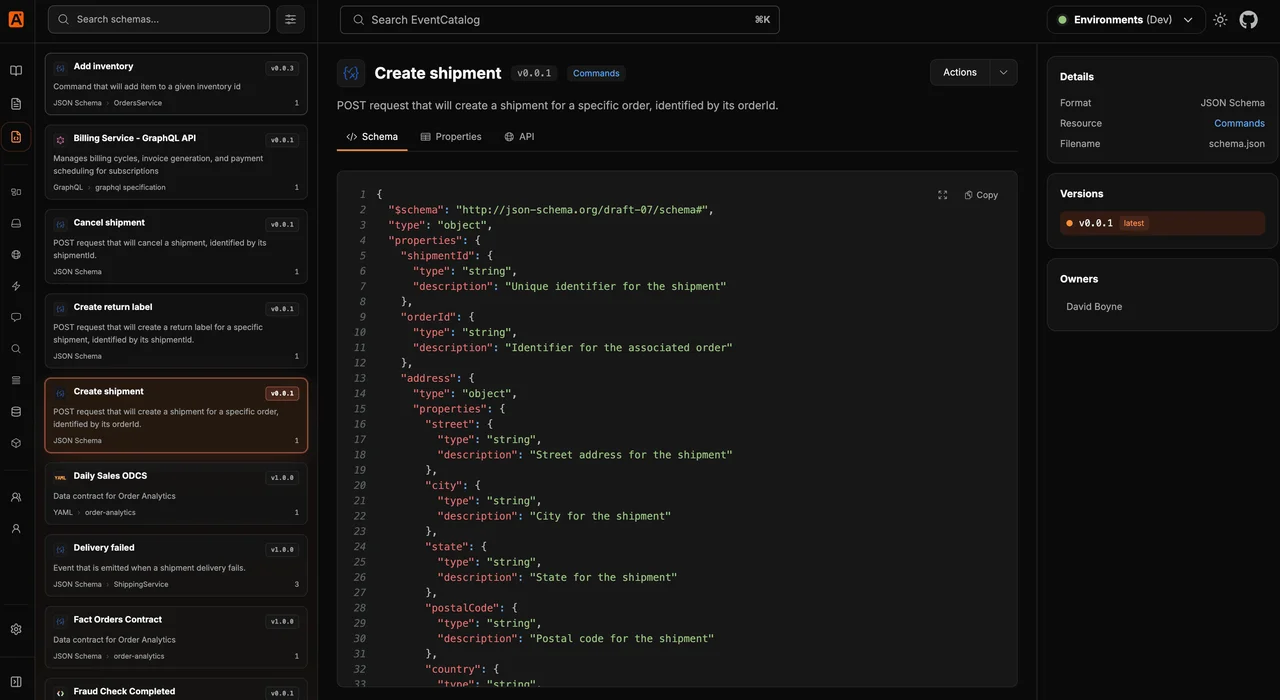
Your specs change. Your docs update.
Connect your OpenAPI, AsyncAPI, or broker specs. Run one command in CI/CD. Your catalog updates automatically.
Devs find what they need. Architects see the big picture. PMs finally understand the system.
One source of truth for every role. Developers search for schemas. Architects trace dependencies. PMs explore business flows.
Sync with your specs and code across your organization.
Integrations









Any specification, any broker, any schema
Bring what you already have
OpenAPI, AsyncAPI, GraphQL, Avro, Protobuf, JSON Schema. Import them all. EventCatalog wraps each spec with ownership, relationships, and diagrams.
No more spec sprawl
Specs from different repos, teams, and registries show up in one catalog. Assign each to a domain, a service, and an owner.
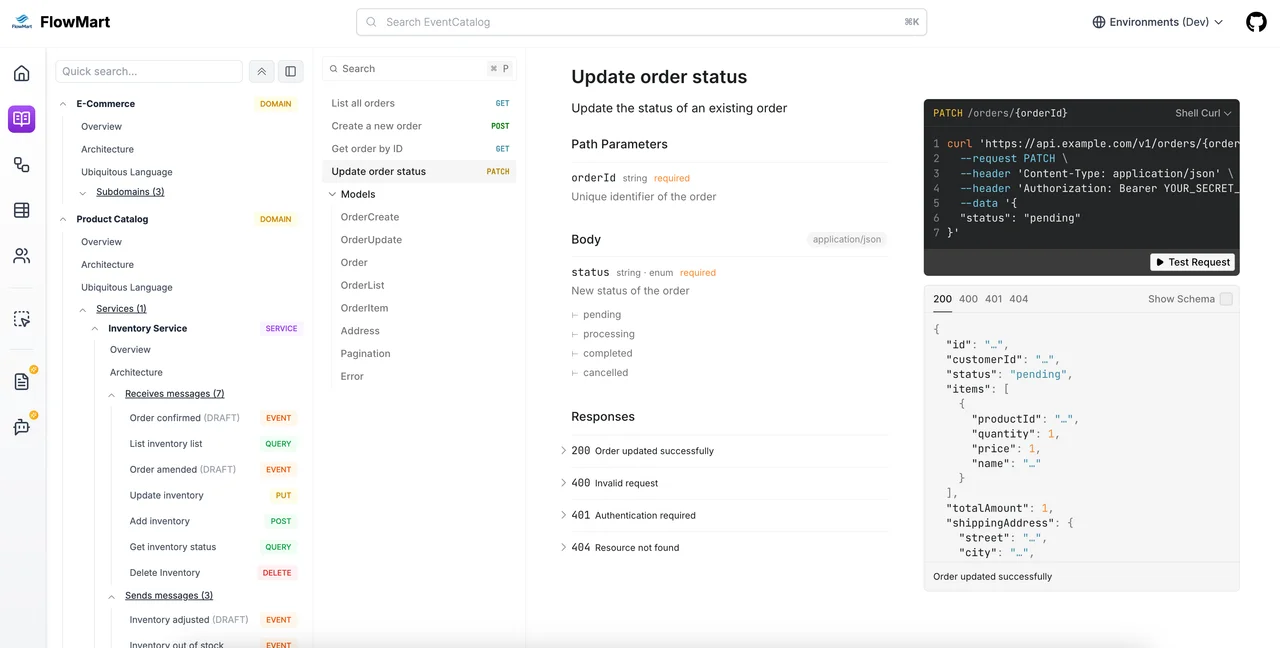
Version every spec
Every schema version is preserved. Compare what changed between releases, and see exactly when a breaking change was introduced.
One catalog, every audience
Engineers find schemas. Architects map boundaries. PMs trace business processes. All from the same Git-based catalog.
Ask your architecture anything
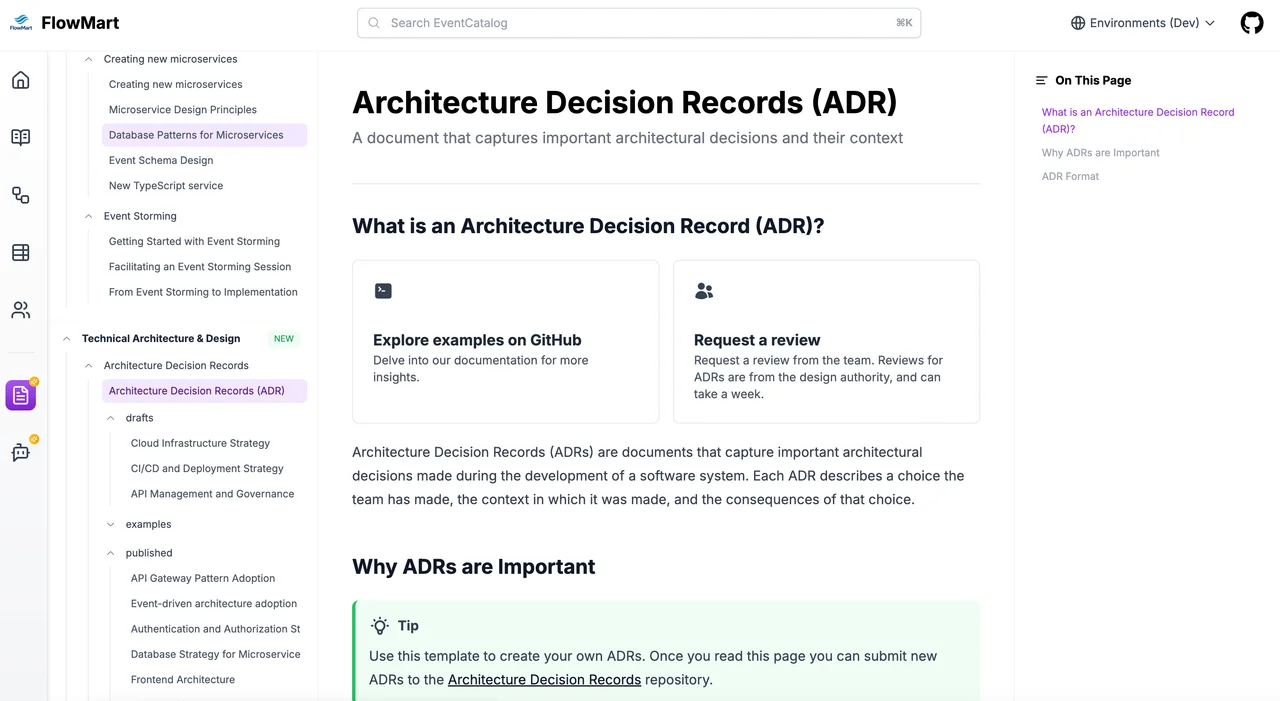
ADRs, runbooks, RFCs, alongside your architecture
ADR-003: Event-Driven Architecture
ActiveDecision to adopt event-driven patterns for order processing
Payment Service Deployment
RunbookStep-by-step guide for deploying payment service updates
RFC-012: API Versioning Strategy
DraftProposal for standardizing API versioning across services
Start for free
Join the teams behind 31,000+ catalogs
Self hosting documentation and governance for your organization.