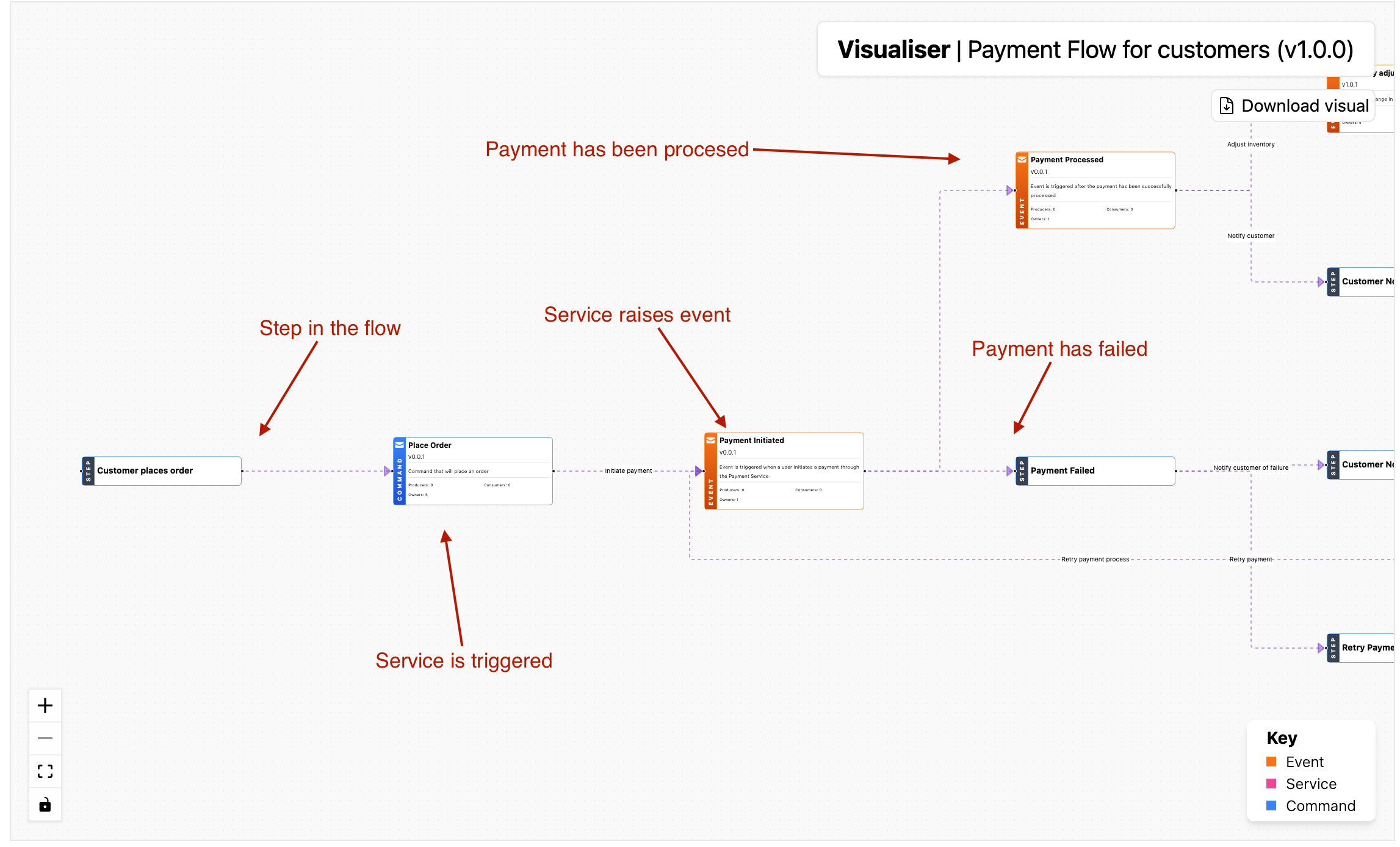
Creating flows
eventcatalog@2.5.0Flows live in a /flows folder. EventCatalog will discover any index.mdx file inside a flows directory, regardless of where that directory lives in your catalog.
You can place flows:
- At the root of your catalog:
/flows/{Flow Name}/index.mdx - Inside a domain:
/domains/Orders/flows/{Flow Name}/index.mdx - Inside a service:
/services/PaymentService/flows/{Flow Name}/index.mdx - In subdirectories to group related flows:
/flows/Payments/{Flow Name}/index.mdx
The contents are split into two sections, frontmatter and the markdown content.
Here is an example of what a flow file may look like.
---
id: "CancelSubscription"
name: "User Cancels Subscription"
version: "0.0.1"
summary: "Flow for when a user has cancelled a subscription"
steps:
  - id: "cancel_subscription_initiated"
    title: "Cancels Subscription"
    summary: "User cancels their subscription"
    # define the actor for, in this case it's a user.
    actor:
      name: "User"
    # What happens next? Define the next step
    next_step:
      id: "cancel_subscription_request"
      label: "Initiate subscription cancellation"

  - id: "cancel_subscription_request"
    title: "Cancel Subscription"
    # This step is a message, include the message and version
    message:
      id: "CancelSubscription"
      version: "0.0.1"
    next_step:
      id: "subscription_service"
      label: "Proceed to subscription service"

  - id: "stripe_integration"
    title: "Stripe"
    # This is an external system (e.g Stripe)
    externalSystem:
      name: "Stripe"
      summary: "3rd party payment system"
      url: "https://stripe.com/"
    next_step:
      id: "subscription_service"
      label: "Return to subscription service"

  - id: "subscription_service"
    title: "Subscription Service"
    # This node is a service, include that.
    service:
      id: "SubscriptionService"
      version: "0.0.1"
    # Define multiple steps
    next_steps:
      - id: "stripe_integration"
        label: "Cancel subscription via Stripe"
      - id: "subscription_cancelled"
        label: "Successful cancellation"
      - id: "subscription_rejected"
        label: "Failed cancellation"

  - id: "subscription_cancelled"
    title: "Subscription has been Cancelled"
    message:
      id: "UserSubscriptionCancelled"
      version: "0.0.1"
    next_step:
      id: "notification_service"
      label: "Email customer"

  - id: "subscription_rejected"
    title: "Subscription cancellation has been rejected"

  - id: "notification_service"
    title: "Notifications Service"
    service:
      id: "NotificationService"
      version: "0.0.2"

---

This flow documents what happens when a User Cancels Subscription in our system.

<NodeGraph />

<!-- Add any markdown you want, the workflow will also render in its own page /docs/flows/{Flow}/{version} -->
Once this file is added, the event will automatically appear across EventCatalog.
Organize with subdirectories
You can group related flows by placing them in subdirectories inside any flows folder. EventCatalog will discover them regardless of nesting depth.
flows/
  Payments/
    ProcessPayment/
      index.mdx
    RefundPayment/
      index.mdx
  Subscriptions/
    CancelSubscription/
      index.mdx
The flow id in your frontmatter is what EventCatalog uses for routing and references. The directory structure is purely for organization.
Add badges
Badges appear on the flow page and in catalog listings. Use them to label flows by category, status, or team, and users can filter flows by badge.
---
id: ProcessPayment
name: Process Payment
version: 1.0.0
badges:
  - content: Payments
    backgroundColor: blue
    textColor: blue
  - content: Critical
    backgroundColor: red
    textColor: red
---
Write flow content
You can write any Markdown inside a flow.
Each flow gets its own page, so use this space to fully explain how it works.
You can also use interactive components to enrich your documentation.
Add child flows / reusable flows
eventcatalog@2.34.2You can reference a flow from another flow. This lets you reuse flows in your flow diagrams, useful if you have complex flows that reuse information from another flow.
To reference a flow from another flow, use the flow node type.
steps:
  - id: "step-1"
    title: "Example Step of a Event"
    flow:
      id: "order-flow"
      version: 0.0.1
This will render the order-flow within the described flow.
Right clicking on the order-flow node will let you navigate to the referenced flow.
Expand sub-flows inline
eventcatalog@3.29.0Click any sub-flow node in the visualiser to expand its steps inline inside the parent flow diagram. Click the Collapse button in the expanded node's header to restore the single-node view.

Expanded steps participate in the step-by-step walkthrough, so you can navigate through them using the next/previous controls without leaving the parent flow. Nested sub-flows (a sub-flow that itself references another flow) also expand correctly.
Tips for flow content
It's entirely up to you what you want to add to your flows markdown content but here are a few things you might want to consider.
- Context of the flow. What is it? Why does it exist?
- Examples of how to trigger the flow?
- Any edit/contributing guidelines?
What do flows look like in EventCatalog?